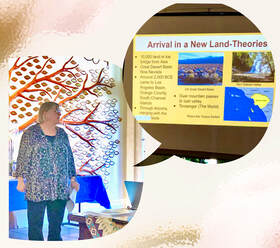
 If you would like to learn more about Ms. Ogden's research studies, please reach out to MOHPG.org. | The Monrovia Historical Museum would like to thank the Monrovia Historic Preservation Group (MOHPG) for bringing this opportunity to educate our community! On Sunday, February 11th, they sponsored Ms. Deb Ogden, a retired educator from Duarte, to give a presentation on the Tongva Tribe, a free event held at the Museum and attended by many! In her presentation, Ms. Ogden covered The Tongva's beginnings, from around 4,000 years ago to the present. They brought their unique cultural traits to this bountiful region, teeming with natural resources. They did not see themselves as better than other creatures but as a part of the web of life. That all changed with European exploration and colonization in the 1770s when the San Gabriel Mission was built. The Tongva people were used as slave labor and forced to drop their old ways and adopt Christianity. In the era of Mexican rule, they fared no better. When the Americans gained control of the region, the Tongva were criminalized and forced to work on chain gangs. In the 1920s Tongva children were sent to the Sherman Indian School in Riverside. In more recent times the Tongva have had some of their ancestral sites desecrated, and today there is no federal recognition of the tribe. Some additional reading on Tongva history: https://nahc.ca.gov/cp/tribal-atlas-pages/gabrielino-tongva-nation/ https://nahc.ca.gov/cp/tribal-atlas-pages/gabrieleno-tongva-san-gabriel-band-of-mission-indians/ https://claremontheritage.org/gabrielino_tongva.html |
|
0 Comments
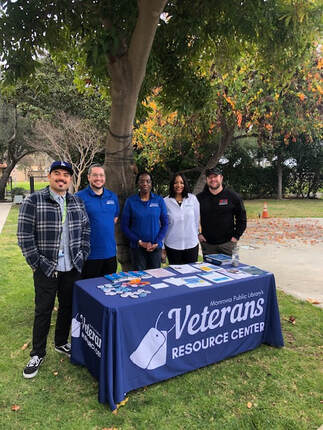 On Saturday, January 20, 2024, the Monrovia Public Library Veterans Resource Center sponsored a breakfast and tour at the Monrovia Historical Museum to honor our local veterans and their families. Council Member Dr. Tamala Kelly was there to show her support for the veterans. Mark Harvis, museum board Vice President, also a board member of the Public Library, was also in attendance, along with museum board members, Oliver Beckwith and Sharon Motheral. The staff at the Veterans Resource Center (pictured) provided information for services available to veterans, and after a continental breakfast in the courtyard, welcome remarks by Mark Harvis, and was followed by a guided tour with Oliver Beckwith. He shared the story about the three Monrovians who paid the ultimate sacrifice at Pearl Harbor: Three Monrovians Who Were Killed At Pearl Harbor Source: Richard Singer, People Like You and Me: A History of Monrovia in World War II, p. 11-13 These are their stories:
As a final note, did you know that 74 Monrovians gave their lives in World War II? A poster honoring these heroes can be viewed in our WWII exhibit (image below). 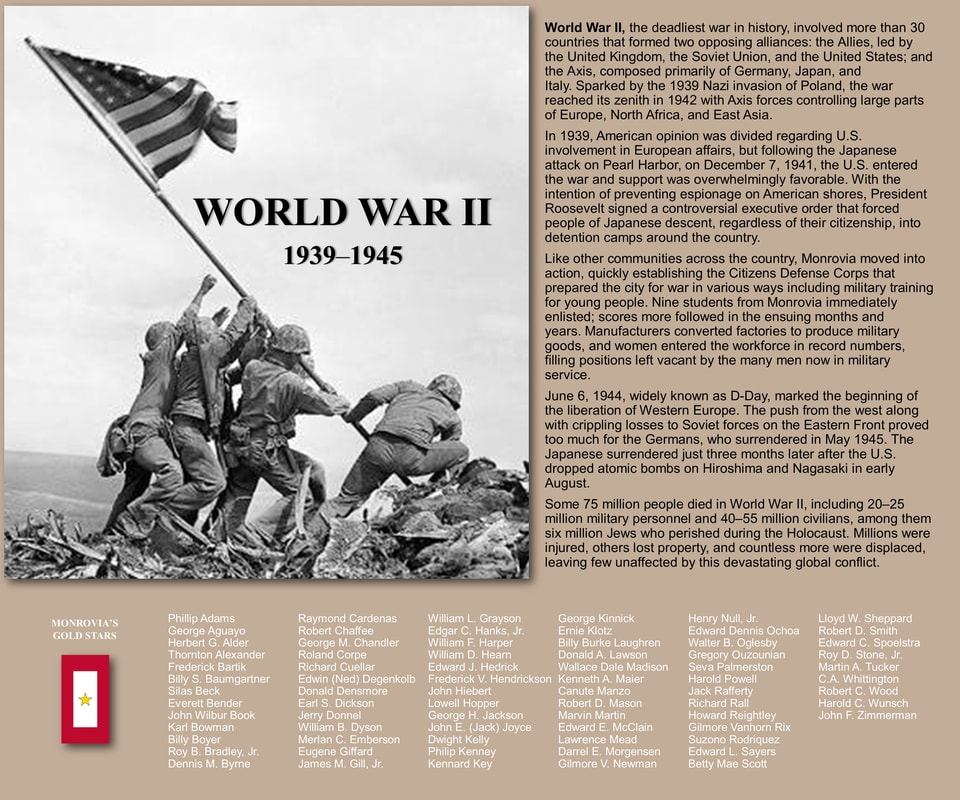 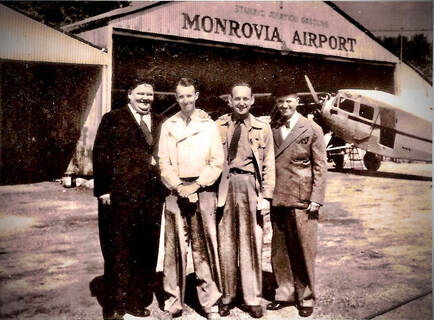 Sarah Farmer Earll, pictured with Dylan Feik, Monrovia City Manager, and Alex Batres, former management analyst at City of Monrovia. Sarah Farmer Earll, pictured with Dylan Feik, Monrovia City Manager, and Alex Batres, former management analyst at City of Monrovia. After retiring as a board member at the Monrovia Historical Museum in March 2023 to pursue her plans to relocate back to Arkansas with her husband, Bryan, Sarah Farmer Earll has continued her commitment to preserving the city's heritage through remote-volunteering, leveraging technology to stay connected and to continue contributing to the museum's mission. Her gracious assistance has not gone unnoticed. We, at the Monrovia Historical Museum, express our deep gratitude for her ongoing support, proving that distance is no barrier to preserving Monrovia's legacy. "Sarah's commitment is exemplary. Her knowledge and passion for history have been a guiding force for the museum, and we're fortunate that she continues to be part of our journey beyond the 5 years she served on our board," remarks Franci Bolen, Board President. Her wealth of knowledge and passion for history played a crucial role in curating exhibits and programs at the museum, especially the Diversity Exhibit that was launched on our 30th Anniversary celebration in 2022 (see photo on right). She also served as Vice President and Board Secretary and managed most of our administrative operations. Today, her remote volunteering serves as a testament to the power of passion and dedication, transcending the physical boundaries of distance, in the pursuit of preserving and sharing Monrovia's history. Thank you, Sarah!
Ruzika Lighting Illuminates the Museum! We're not done yet, but things are looking brighter at the museum, thanks to Tom Ruzika of Ruzika Lighting. In a recent upgrade, Tom has transformed the museum's ambiance, shedding new light on exhibits and artifacts. The enhanced lighting not only illuminates the displays but also provides visitors with a fresh perspective, allowing them to see the rich history and cultural treasures in a whole new light. The museum is now more vibrant and inviting, creating an immersive experience that captivates and delights all who explore its treasures! 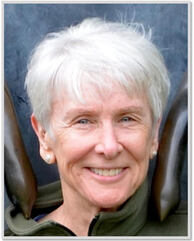 In November 2023, our esteemed museum researcher, Pam Barkas, retired after an incredible decade-long journey. We extend our deepest gratitude to Pam for her unwavering dedication and invaluable contributions to the Monrovia Historical Museum, leaving a legacy of excellence, inspiring current and future generations to explore the fascinating tapestry of history with enthusiasm and diligence. Throughout Pam's tenure, she has been the backbone of our historical endeavors, meticulously unearthing hidden stories, delving deeply in her research to unravel mysteries, and enriching our exhibits with a wealth of knowledge from her scholarly achievements, impassioned research, and her Monrovia connections. Her steadfast commitment to preservation and archiving our collections has truly left an indelible mark on the way we operate as an institution. We are privileged to have known, collaborated and have been mentored by her. Farewell to our esteemed colleague, Pam Barkas! She will always be a cherished member of our museum family! Our sincere thanks for her friendship, endless hours of hard work and immeasurable impact on our institution. 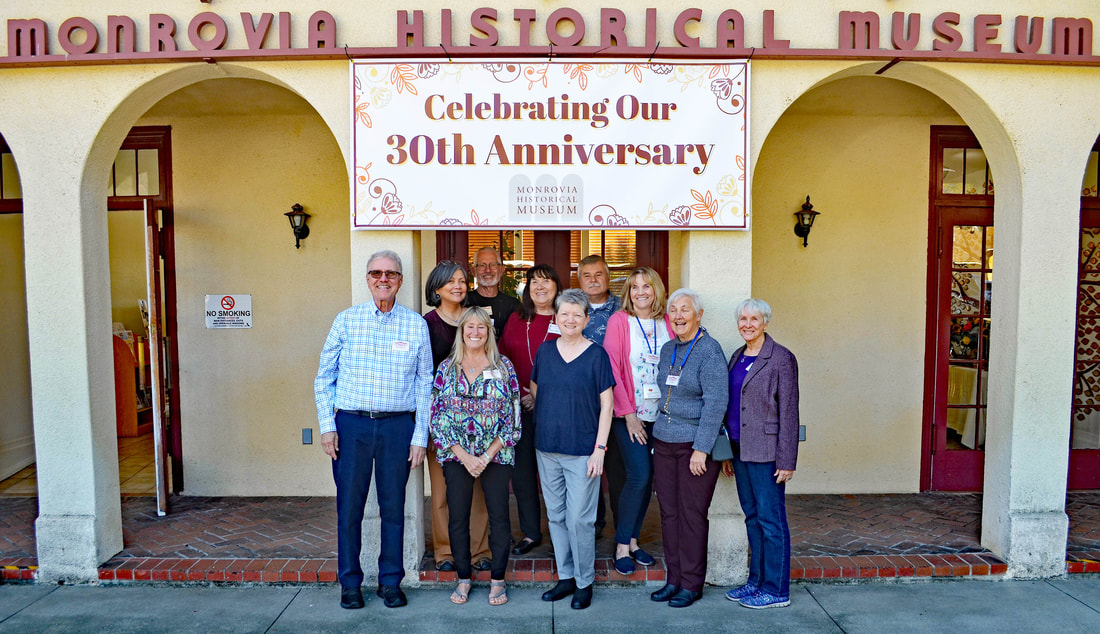 November 2022 during our 30th Anniversary event. Pam Barkas is pictured on the far right, along with the museum board members (listed from left: Oliver Beckwith, Nennette Ferris, Sharon Motheral, Deborah Curlanis, Sarah Farmer Earll, Mark Harvis, Vicky Hansen and Franci Bolen.) 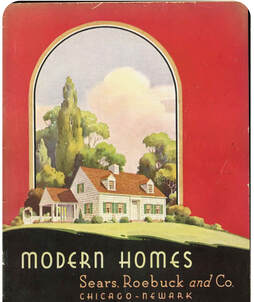 Click image to see this 1936 kit house catalog. Source: dahp.wa.gov Click image to see this 1936 kit house catalog. Source: dahp.wa.gov Have you ever heard of a Kit Home? Did you know that Monrovia is home to many Kit Houses?
In the early 20th century, people sought escape from crowded cities due to high population density and the threat of diseases. The growth of suburban areas, aided by expanded railroad lines and better public transportation, made this escape both possible and convenient. Yet, the expanding middle class faced a challenge – a shortage of affordable housing. Enter the Kit House, a unique solution to the housing challenge of the time. These mail-order homes, also known as mill-cut houses, pre-cut houses, or ready-cut houses, gained popularity in the United States, Canada, and beyond during the first half of the 20th century. Aspiring homeowners, unable to afford the opulent Victorian mansions of the upper class, found a viable option in these kit homes. Kit house manufacturers, operating nationally, offered houses in various plans and styles – from simple bungalows to elaborate Colonials. The concept was straightforward: customers could select a design from a catalog, and the manufacturer would supply all the necessary materials for construction at a fixed price. Notably, materials like brick, concrete, or masonry for the foundation were typically excluded, as customers would arrange for local construction. Click this link to see photos of kit houses. In Monrovia, the history of Kit Homes is just another notable part of Monrovia’s architectural legacy -- see article titled "The Era of The Kit House" written by Jim Wigton of the Monrovia Historic Preservation Group. During this era, six major national companies marketed their designs for these kit homes, with Sears Roebuck and Pacific Homes emerging as dominant suppliers in Southern California. Sears alone presented an impressive 370 designs, providing a myriad of options for customization. Los Angeles-based Pacific Ready-Cut Homes Inc., once the largest home builder in the West, dominated the pre-cut market in Southern California during the company’s pre-Depression peak. Eight decades later, many Pacific Ready-Cut houses still stand in neighborhoods as diverse as Beverly Hills and South Los Angeles. From the exterior, it's challenging to discern whether a house was built from a kit unless you are familiar with the catalog designs. In many cases, even the current owners are unaware that they are residing in a kit home. Kit houses can be identified by the part numbers on exposed wood in the attics or basements. These numbers and labels corresponded to the detailed assembly instructions provided by the kit home company. The labeling system made it easier for individuals with varying levels of construction experience to follow the instructions and correctly piece together the components of the home. This approach was a key aspect of the kit home model, allowing for a more straightforward and efficient construction process. It enabled individuals without extensive construction expertise to successfully build their homes, contributing to the popularity of kit homes during that era. Companies like Sears, Aladdin, and others utilized this numbering system to simplify the assembly process for their customers. While the exact number of kit houses in present-day Monrovia remains unknown, the city's historical rail access and proximity to Pacific Homes in Los Angeles suggest the likelihood of several undiscovered kit houses waiting to be unveiled. As we delve into Monrovia's architectural history, the Kit Homes stand as a testament to the creativity and practicality that shaped the landscape of suburban living in the early 20th century. Some links to read up on kit houses: Sears Roebuck Kit Homes Catalogue 1936 How to Identify Sears Kit Homes How to Identify Kit Homes How to Identify Kit Homes (Historic New England) How to Identify Kit Homes (WikiHow) If you can't come to the Museum, we'll bring the Museum to you! SPECIAL EVENT!
On March 8, the Monrovia Historical Museum and the Monrovia Historical Preservation Group (MOHPG) are co-sponsoring an event on Women’s Suffrage and the 19th Amendment, which has its 100th anniversary this year. The event will include a talk on suffrage by Pauline Field, chairman of 50/50 Leadership, a nonprofit promoting women’s equal leadership based in Glendale. Ms. Field also rode on a Women’s Suffrage float in this year’s Tournament of Roses Parade and will offer comments on that experience as well. There will also be a special exhibit featuring a timeline of significant events in Monrovia history led by women. Please join us at the Museum for this special event on Sunday, March 8, at 1:30 pm. Light refreshments will be served and attendance is free and open to the public. ADDRESS: 742 E. Lemon Avenue, Monrovia, CA 91016 HOURS: Thursday and Sunday, 1:00-4:00pm, or by appointment. |

 RSS Feed