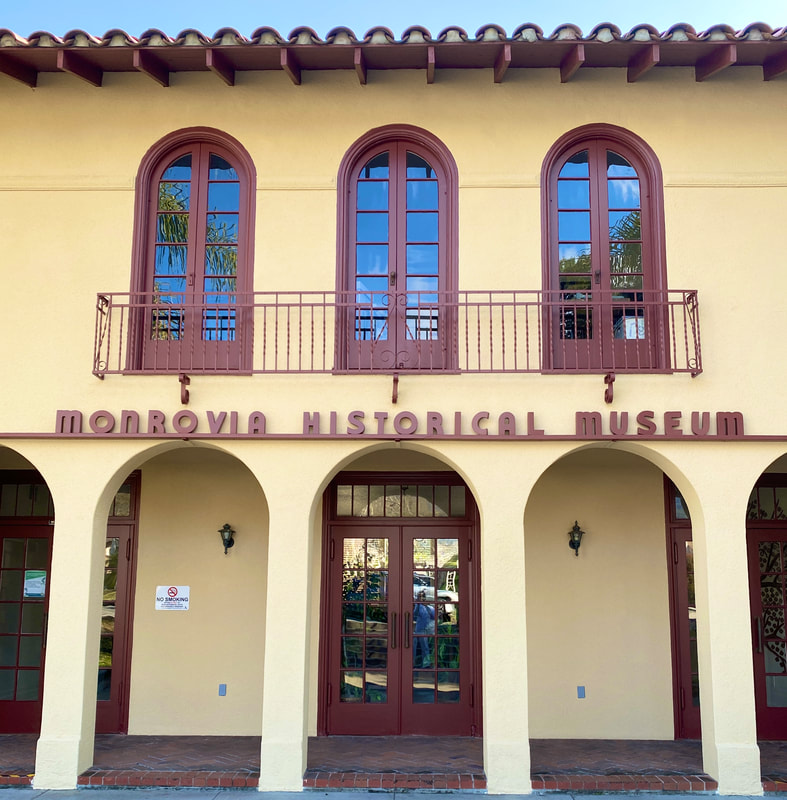
Monrovia Historical Museum
A City of Monrovia Historic Landmark
  • Home
  • About
    • Contact & Map
    • Founding History
    • History of "The Plunge"
    • Board Members & Staff
    • Remembering Steve Baker
    • Newsletters & Signup
  • Visit
    • General Information
    • Collections
    • Videos
    • Tours
  • Donate
    • Our Sponsors
    • Memberships & General Donations
    • Sponsorships
    • Volunteer with us!
    • Artifacts Donations
    • Books & Gifts
  • Resources & Research
    • Research Resources
    • Items From The Archives
    • Monrovia's Almanac
    • Monrovia's Olympic Athletes
    • Children's Activities
    • Other Local Museums
  • Museum Musings (Our Blog)
    • Announcements & Tributes
    • Mark's Trivia Questions
    • Museum Happenings
    • Other Historical Musings
    • Volunteers' Stories
  • Events
    • City Events
    • Online Yard Sale

Did you know ‘The Doors’ played at Monrovia High School’s Auditorium— Promoted by Arcadia High School?

8/3/2026

0 Comments

 
PictureFrom the museum archives, the April 1967 concert ticket donated by a Monrovia High alumni.
Friendly rivals for decades, the two high schools came together for one unforgettable evening in 1967. Here's the remarkable story of how a student promoter from Arcadia High brought a little-known rock band to the stage at Monrovia High—just weeks before "Light My Fire" made music history. 

Just weeks before they became famous on the radio and “Light My Fire” hit #1 on the charts, The Doors played on April 28,1967 in Monrovia High School’s Auditorium.


Read More
0 Comments

Kiyoshi Kuromiya: Activist and Neighborhood Treasure

7/1/2026

3 Comments

 
Picture
​On May 2nd, 2026 the Monrovia Area Partnership unveiled their latest Neighborhood Treasure Monument, a program dedicated to celebrating historically significant Monrovians. The monument is
located at 934 Royal Oaks Drive in East Monrovia, across the street from where the honoree, Kiyoshi Kuromiya, was raised. It was a meaningful event with the entire city council, representatives of the historical community, and family members in attendance.

Of all the people who lived in Monrovia in the past 140 years only one person has been honored with a Google Doodle, and Kiyoshi Kuromiya (1943-2000) is that person. Kiyoshi was a Sansei, a third generation Japanese American, born at the Heart Mountain concentration camp in 1943. After the war his family returned to Monrovia.

At Monrovia High School, Kiyoshi, called 'Steve' by his classmates, excelled academically. He was Vice President of the History Club and received a scholarship to attend the University of Pennsylvania as an architecture major. Once there he became an activist; he joined the Anti-War Students for a Democratic Society (SDS), and the Congress On Racial Equality (CORE), a major group in the Civil Rights Movement.


Read More
3 Comments

Monrovia High School: 140 Years of Excellence

6/5/2026

0 Comments

 
PictureMonrovia High School in 1907. Click image to see link to the collection, courtesy of the Monrovia Legacy Project.
​By Oliver Beckwith

​Since the beginning of Monrovia’s existence to the present time, educating young people has been a key factor in fostering and maintaining the success of the city. City fathers recognized it; the first school, Orange Avenue School (now Monroe Elementary), was constructed in 1887 on land donated by William Monroe. The building had two stories, with elementary grades meeting on the first floor and the high school located on the second floor.
 
Early on Monrovia had a reputation for academic excellence. An early Superintendent was James A. Foshay (1856-1914). Foshay went on to become the Los Angeles City Superintendent of Schools. In 1925 Foshay had a school named after him and today it’s still educating students. The James A. Foshay Learning Center in Exposition Park is a testament to the memory of this Monrovia educator. 


Read More
0 Comments

The Unique Aztec Hotel: A Century of History

4/25/2026

0 Comments

 
Picture
By Oliver Beckwith

​One of the more unusual structures to be found along Route 66 is found right here in Monrovia. There is nothing like the Aztec Hotel anywhere along the eight  states and more than 2400 miles of the Mother Road. Yet despite its uniqueness the place has never been a successful business venture. In order to find out why, questions need to be answered. Why was it built there in 1925, and what caused investors to have it built? Why did they choose such an unusual architectural style at that time, and why did it ultimately fail? 


Read More
0 Comments

The Wonderful Wizard of Oz, Route 66 and Monrovia?

4/6/2026

0 Comments

 
PictureSource: Wikipedia
By Oliver Beckwith

In concert with the grand opening celebration of our new Route 66 exhibit, "Engines of Change: How Transportation Moved Monrovia," I was inspired to take a journey into some of the many historical connections Monrovia has with the Mother Road. This month, my focus is on one of the key parts of our new exhibit involving "The Good Roads Movement," one of many reforms that came out of the Progressive Era.

​​​The Good Roads Movement and Route 66

The Good Roads Movement was one of many reforms that came out of the Progressive Era, which lasted from the 1890s to the 1920s. The initial goal was to improve roads for rural farmers. The Progressive Movement had many parts designed to make life better for all Americans. Among these were political, economic, and social reforms, many of which we still have today.


Read More
0 Comments

More Comings and Goings on Route 66

4/4/2026

1 Comment

 
By Susie Ling
A note from Oliver Beckwith: Susie Ling is a well known oral historian in Monrovia who volunteers with the Monrovia Historical Society. She has conducted more than 200 oral histories of local African American, Asian American, and Mexican American people. Because of segregation, these were the people who lived along Route 66 as it traversed through Monrovia on Huntington Drive. Here are some of their stories. 
​Rosalie Cardiel Garcia lived on Monrovia’s Route 66 in the 1930s, "We used to live on Huntington Drive... When I drive down Huntington [today], I would remember when my brother and I would lie down on that street. There wasn't that much traffic [then]. We would be lying there, and my brother would say, 'Oh, there's the light of a car way down there...' So we would then get up to let the car pass. Then we would lie on the street again. We played hopscotch on Route 66. There was an airport next to us. When it was really foggy, they would blow a horn. Then the men would all go to the airport with their cars and turn their headlights on for the incoming plane." Rosalie married Louis Garcia, grandson of Lucinda Garcia. This Garcia family traces their legacy on this land to before the Spaniards built the San Gabriel Mission in 1771.
Picture

​From Henry Olivas: This circa 1925 photo shows my Great-Grandmother Lucinda Garcia (far right) along with her husband (far left), my Great-Grandfather Louis and most of their children, (back row L-R) Louis Jr., Dora, Grace, an unidentified man and Josefa, (front row L-R) Florence (Vivi), Alex, an unidentified girl and youngest daughter Clara (my grandmother). Not shown are additional siblings Manuel and Ernest (possibly cropped from the picture. They're posing in front of their Monrovia home, where I now reside.
I remember seeing this photo as a child, and for decades considered it lost. I was overjoyed to discover it yesterday among a slew of pictures my late mother, Rosalind Olivas, had stored away.


Read More
1 Comment

1887: SALOONS AND MONROVIA'S INCORPORATION

2/18/2026

0 Comments

 
PictureSource: Monrovia Legacy Project

By Oliver Beckwith

At the Monrovia Historical Museum, I enjoy telling our guests the story of our city’s beginnings. I often share that the city’s 1887 incorporation story has something to do with saloons and the founders’ desire to get rid of them. The community began in May of 1886, and by the fall of 1887 Monrovia was growing quickly.​

​Saloons were allowed in Los Angeles County, thus they were allowed in


Read More
0 Comments

the bear and Monrovia’s Canyon Park: Historical Connections

2/9/2026

1 Comment


CANYON PARK IN THE ​20TH CENTURY AND BEYOND
​by Oliver Beckwith, MHM Board Member

Picture
​Part Two of Two
(to re-read Part One, click here)
​
​From the beginning of Monrovia’s existence as a city there was awareness of Monrovia Canyon and its falls. Local residents would hike or take horses up there and enjoy the visit. With the introduction of automobiles in the early 20th century there was a desire for residents to visit the place in their vehicles. 

Read More
1 Comment

The Bear and Monrovia’s Canyon Park: Historical Connections

1/1/2026

0 Comments

 
By Oliver Beckwith, MHM Board Member
Picture
​

​​Part One of Two

The Bear is a book by author Andrew Krivak, and it is the featured book in Monrovia's "One City
One Story" initiative for 2026. It’s sponsored by Monrovia Reads, a local group which promotes
literacy and provides resources to accomplish this goal. ​The Bear is about a journey by a father
and daughter in a post apocalyptic world, and themes of human interaction with the natural
world abound. 

Read More
0 Comments

Route 66 and Monrovia: A Shared History

11/9/2025

2 Comments

 
​By Oliver Beckwith, MHM Board Member
Picture
In the first four decades of Monrovia’s existence, modes of transportation in the city had been changing. In the early years the train was the main mode of transportation. Passengers arrived at the Santa Fe Station. Next they were taken into town on a mule drawn trolley. In 1903 the Pacific Electric train line was added, making trips to Pasadena and Los Angeles relatively easy. The twentieth century also saw the advent of the automobile, and before too many years had passed, people were driving to and from Monrovia in their Studebakers, Oldsmobiles, or Fords.

Read More
2 Comments
<<Previous

    spotlight on
    monrovia history

    Picture
    With Oliver Beckwith
    and Friends

    Archives

    August 2026
    July 2026
    June 2026
    April 2026
    February 2026
    January 2026
    November 2025
    September 2025
    July 2025
    April 2025
    March 2025
    February 2025
    November 2024
    October 2024
    September 2024
    August 2024
    July 2024
    June 2024
    May 2024
    April 2024
    March 2024
    February 2024
    December 2020
    July 2020
    March 2020
    June 2019
    January 2019
    April 2018
    February 2018
    January 2018
    December 2017
    October 2017
    September 2017
    August 2017
    May 2017
    February 2016
    September 2015

    Categories

    All
    1903
    1915
    Filming
    Pacific Electric

    RSS Feed

HOME
ABOUT
Board of Directors
​
Founding History 
History of "The Plunge"
​
VISIT
Contact & Map
​General Info
Museum Rental Info
​
Tours


RESEARCH & RESOURCES
Our Blog
Our Collection
Research


GET INVOLVED
​Become a Member
Donate
Email us
​
Newsletters & Signup

Volunteer
742 E. Lemon Ave, Monrovia | 626-357-9537 | [email protected]
All Content © Copyright 2023  except as noted | ​The Monrovia Historical Museum Foundation, Inc